
One way to do that is by using the Hurst exponent. Referred to as the "index of dependence", the Hurst exponent measures the long-term memory of time-series, that is, their autocorrelation. Steps - Download the Hurst exponent indicator from Estimation of the Hurst Exponent - Trading Indicator. - Once the trading indicator is downloaded, click on "Display" in the new form. Alternatively, you can create a new pane on a chart by right clicking on it then selecting "Create a new pane". In this new pane, add the new indicator (Hurst). Interpretation of the Hurst exponent Between 0 and 0.5: The security is predictable. A decrease in the security price is likely to be followed by an increase (Negative autocorrelation) Around 0.5: The security or stock price is unpredictable (Random walk) Between 0.5 and 1: The security is predictable. An increase in the security price is likely to be followed by another increase (Positive autocorrelation). Example of trading rule based on the Hurst exponent randomwalk = sma(Hurst(), 10) > 0.49 and sma(Hurst(), 10) < 0.51; 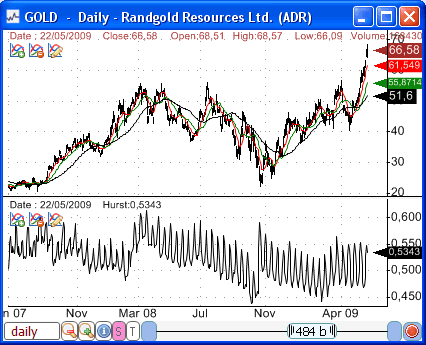
|

|
|
|
|




